Track Saw vs. Table Saw: The Small-Shop Cutting Decision
They look like rivals, but they solve different problems. A clear-eyed guide to choosing the one machine your workshop actually has room for.
Ask a room of woodworkers which saw belongs at the centre of a small shop and you will start an argument. The track saw has taken ground that the table saw held for decades — and the honest answer is that they are not really competing for the same job.
The debate matters because most home workshops have room for exactly one big cutting decision. Get it right and the shop flows. Get it wrong and you spend every project fighting the machine, or working around a tool that sits in the corner covered in offcuts.
What each tool is actually for
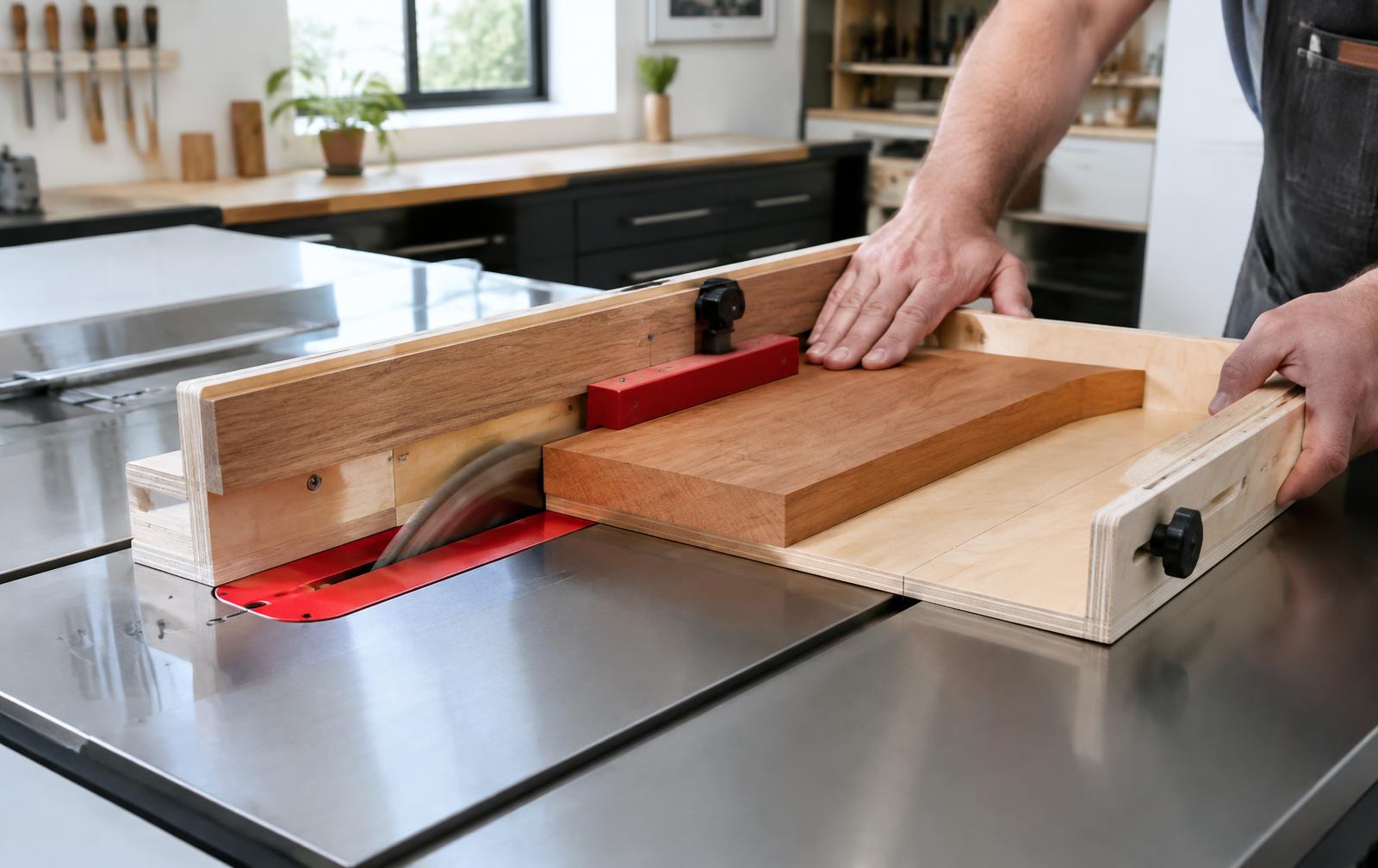
A table saw is a fixed machine: the blade stays still and you move the work past it. That arrangement is unbeatable for repeatable narrow rips, because the fence guarantees an identical dimension on part after part. Add a crosscut sled and it becomes the fastest route to square, matching components.
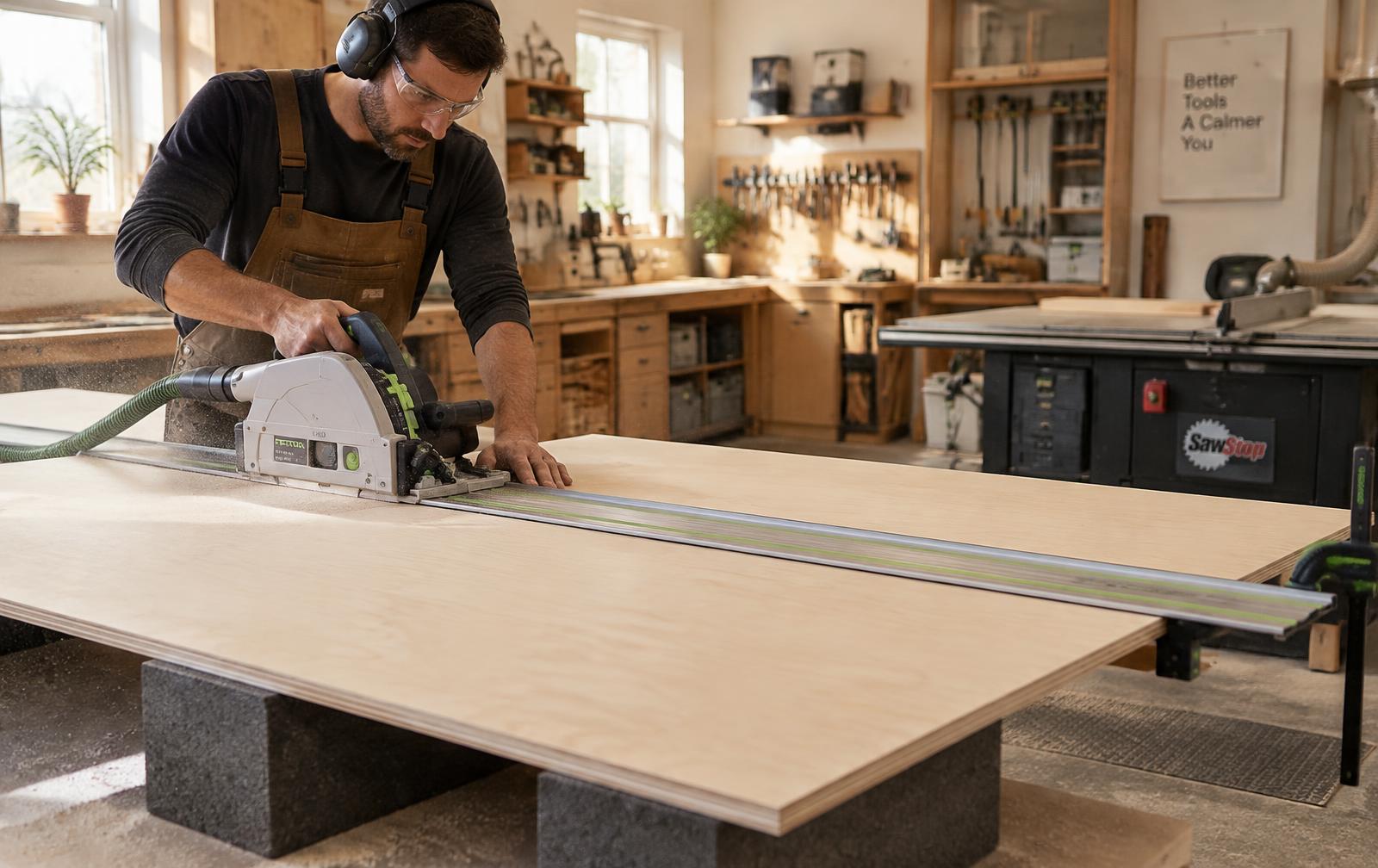
A track saw inverts the relationship: the work stays still and a guided saw travels over it. For breaking down a full sheet of plywood, that is transformative. The sheet never has to be balanced on a small cast-iron table, and the cut lands exactly where the rail's rubber splinter guard sits.
Accuracy: different kinds of precise
Both tools cut accurately when set up well, but the accuracy behaves differently. A table saw's precision is dimensional and repeatable — set the fence once and every part matches. A track saw's precision is positional — you align the rail to marked points, so each cut is only as good as the two marks that located it.
The practical consequence: cutting twenty rails at 2 ⅜ in is table saw work. Cutting six cabinet sides from a sheet is track saw work. Reverse those and you will feel it immediately.
Where table saws lose accuracy
Large panels overwhelm a small table. Without outfeed and side support, the sheet tips, the cut wanders, and the operator ends up in a position that is both inaccurate and unsafe. Support is not optional at that size.
Where track saws lose accuracy
Rail deflection, a workpiece that shifts mid-cut, and cumulative marking errors across many small parts. Clamps and a dedicated cutting table solve most of it, but narrow repeat rips remain slow.
Space, noise and the shared garage
A table saw needs its footprint plus clearance on four sides — realistically two to three times the machine's own area if you intend to process long stock. A track saw stores on a shelf and works on foam blocks on the floor or on a cutting table you can stack away.
Dust also differs. A track saw's shrouded blade connected to an extractor captures a high share of the dust at source; an uncovered table saw throws it into the room. If the shop is a garage attached to a house, that difference is worth taking seriously. Whichever machine you choose, treat fine wood dust as a genuine health hazard and read the OSHA guidance on wood dust rather than relying on shop folklore.
Safety, plainly
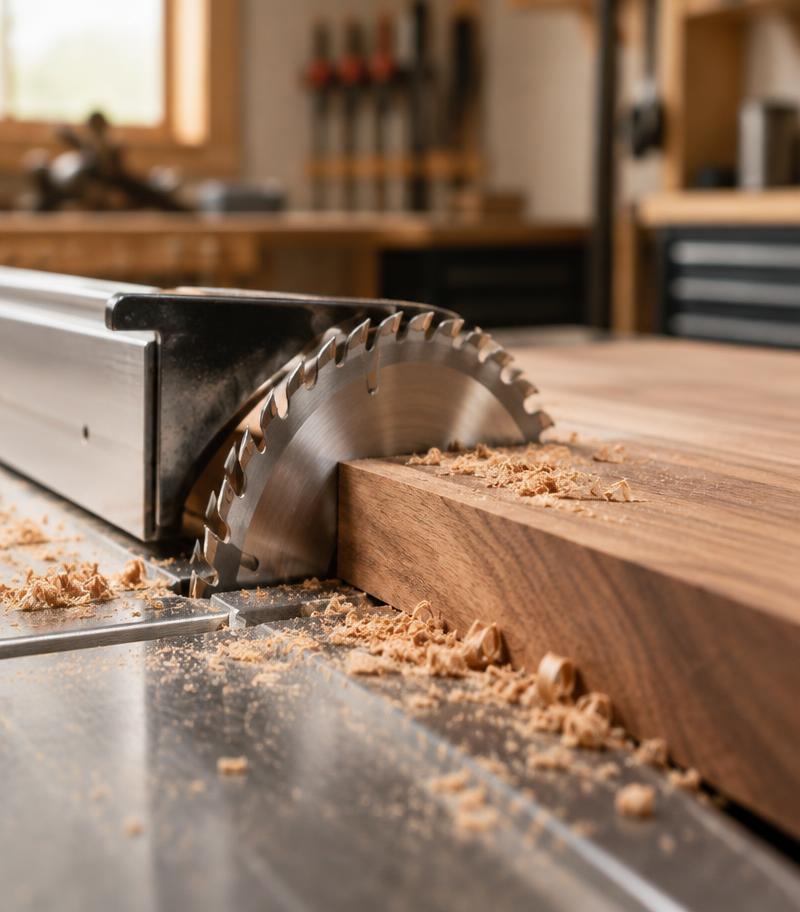
Table saw injuries are usually kickback-related: the workpiece binds between blade and fence and is thrown back. A properly set riving knife, a correctly aligned fence, and push devices address most of the risk, and blade-detection technology addresses some of the rest.
A track saw's blade is enclosed above the material and plunges into it, which removes several failure modes — though it introduces its own discipline: clamp the rail, keep the cable clear, and never reach under the sheet. Neither tool is safe by category. Both are safe by setup and habit.
What the work you do should decide
- Mostly sheet goods — built-ins, cabinets, wardrobes, plywood furniture. Track saw first.
- Mostly solid timber — tables, chairs, frames, batches of identical rails. Table saw first.
- Small or shared shop — a track saw plus a solid bench will get you further than a table saw you cannot walk around.
- Site work — a track saw travels; a table saw mostly does not.
A worthwhile middle route exists too: a track saw for breaking sheets down to rough size, then a compact table saw for final dimensioning. That pairing covers more ground than either tool does alone, and it is why many small professional shops run both.
Setup beats spending
The quickest way to improve either machine is not to replace it. Fit a blade matched to the material — a high tooth count for plywood and melamine, fewer teeth for ripping solid stock. Check that the blade is parallel to the slots or to the rail. Support the work so it cannot move. Then prove the setup on an offcut from the same board before committing to the real piece.
If accuracy is the part that keeps slipping regardless of the machine, the fix is usually process rather than hardware. a precision cutting setup guide walks through the alignment checks and jig work that make cuts repeatable, which is a cheaper improvement than another saw.
A modest saw that is set up correctly outperforms an expensive one that has never been checked.
Budgeting the decision
Compare complete systems rather than headline prices. A track saw needs rails, connectors, clamps, an extractor and a sacrificial support surface. A table saw needs a stand, outfeed support, a sled, and often a better fence than the one supplied. Both numbers land higher than the box price suggests, and both are worth spending once rather than twice.
Key differences at a glance
- Repeat narrow rips: table saw, decisively.
- Full sheets, single-handed: track saw, decisively.
- Dust at source: track saw with an extractor.
- Storage footprint: track saw.
- Speed across a batch of identical parts: table saw.
- Portability: track saw.
Whichever machine you choose, the setup decides the result: a precision cutting setup guide covers the alignment work, a deep library of woodworking project ideas supplies projects that put it to use, and detailed shed and workshop plans is the place to start if the shop around the saw still needs building.
The outlook
Cordless track saws and better rail systems keep narrowing the gap for panel work, while table saws continue to evolve around safety and dust capture rather than raw power. Expect the small shop of the next few years to look less like a machine room and more like a bench with a rail beside it — and expect the deciding factor to stay what it has always been: the work you actually make, most weekends.